
Maestro2 OCT Fundus Camera and the Hood Report for Glaucoma: Advanced Detection and Management
Glaucoma, often referred to as the “silent thief of sight,” is a leading cause of irreversible blindness worldwide. Early detection and timely intervention are crucial in managing this condition. The Hood Report for Glaucoma, a well-established analysis tool, when combined with the advanced imaging capabilities of the Maestro2 OCT Fundus Camera (Optical Coherence Tomography), provides eye care professionals with a powerful array of tools in the fight against glaucoma.
What is the Hood Report for Glaucoma?
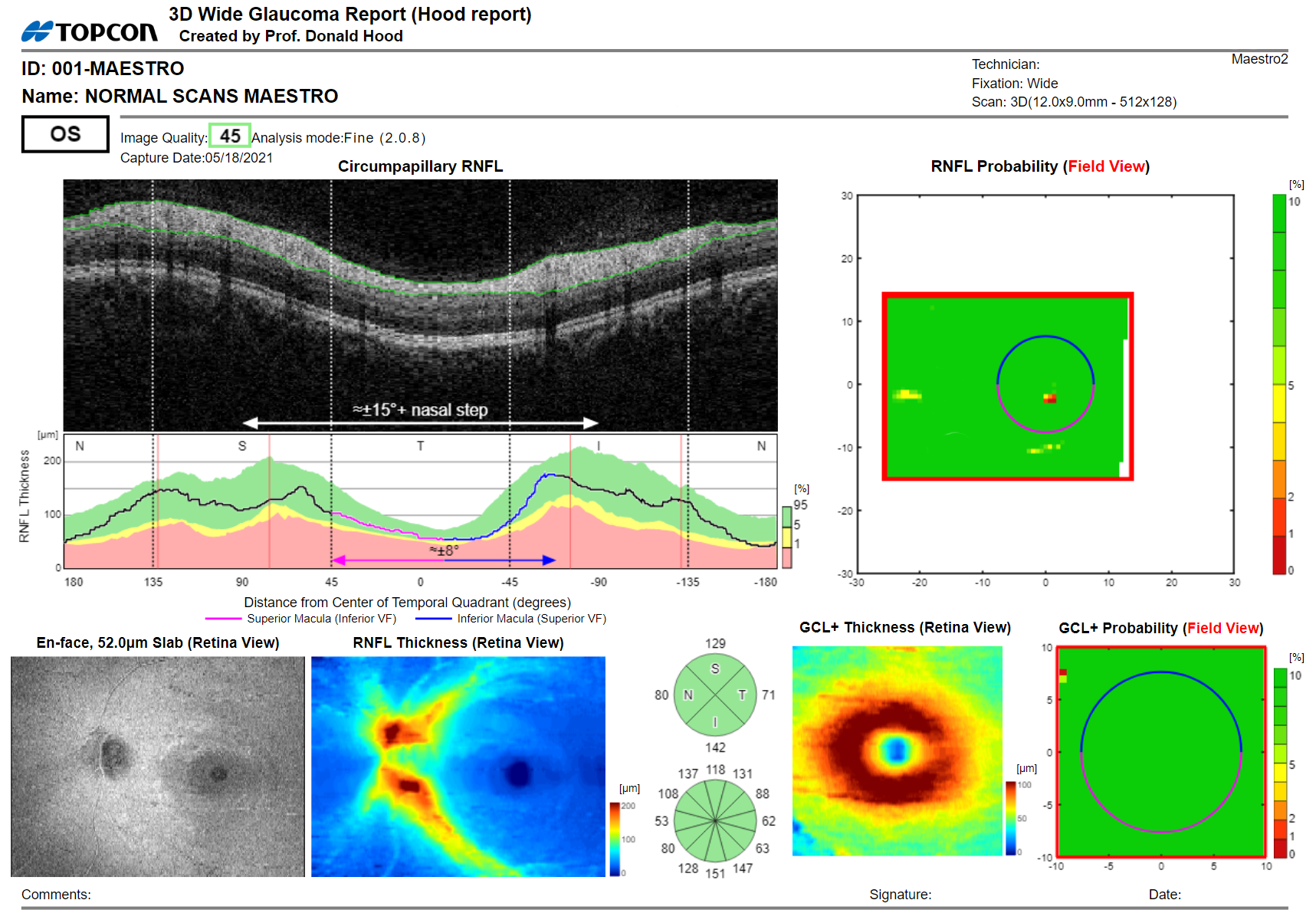
The Hood Report is a comprehensive analysis tool developed specifically for glaucoma assessment by Prof. Donald C. Hood, PhD, a renowned expert in glaucoma research, based at Columbia University. It utilizes data from the Maestro2, which provides detailed cross-sectional images of the optic nerve and macular areas obtained in just one scan. The Hood Report processes and logically presents data, metrics, and color-coded maps that help identify structural changes commonly associated with glaucoma.

Key Features of the Hood Report:
- RNFL Analysis: The report includes detailed measurements and imaging of the Retinal Nerve Fiber Layer (RNFL), a key retinal layer to assess for glaucomatous damage. It compares a patient’s RNFL thickness to an age-matched reference database, highlighting areas of thinning that may suggest disease presence or vulnerability.
- Ganglion Cell-inner Plexiform Layer (GCL): The Hood Report also provides information about the GCL, which is another important retinal layer affected by glaucoma. It identifies areas of GCL thinning and provides an overall assessment of GCL health as compared to an age-matched reference database.
- Color-Coded Thickness and Probability Maps: The Hood Report generates easy-to-interpret color-coded maps that highlight areas of RNFL and GCL abnormalities. These maps allow for quick identification of potential glaucomatous damage.

Advantages of Using the Hood Report with Maestro2 OCT:
- Early Detection: The Hood Report’s ability to help identify subtle structural changes in the optic nerve and surrounding retinal layers may enable early detection of glaucoma, even before significant vision loss occurs.¹
- Standardized Framework for Assessment: The Hood Report provides objective and quantitative measurements, reducing the subjectivity often associated with traditional glaucoma assessment methods.
- Disease Progression Monitoring: Hood Reports obtained over several visits can be used to assess changes in RNFL and GCL over time, allowing for effective monitoring of disease progression and treatment efficacy.
- Enhanced Communication: The color-coded thickness maps and easy-to-understand metrics make it easier for clinicians to communicate findings to patients, improving patient education, engagement, and treatment compliance.
OCT Angiography (OCTA) on Maestro2:
The Maestro2 OCT Fundus Camera also features OCT Angiography (OCTA), a noninvasive imaging technique that visualizes blood flow in the retina without the need for intravenous injection. OCTA detection of early microvascular changes associated with glaucoma is an emerging topic that may further aid in its diagnosis and management.
Maestro2 and the Hood Report for Glaucoma
The combination of the Maestro2 with the Hood Report and OCTA represents a significant advancement in glaucoma care. By providing detailed structural and vascular information, these tools may enable early detection, objective assessment, and effective monitoring of glaucoma progression. This ultimately empowers eye care professionals to deliver personalized treatment plans and preserve their patients’ vision.
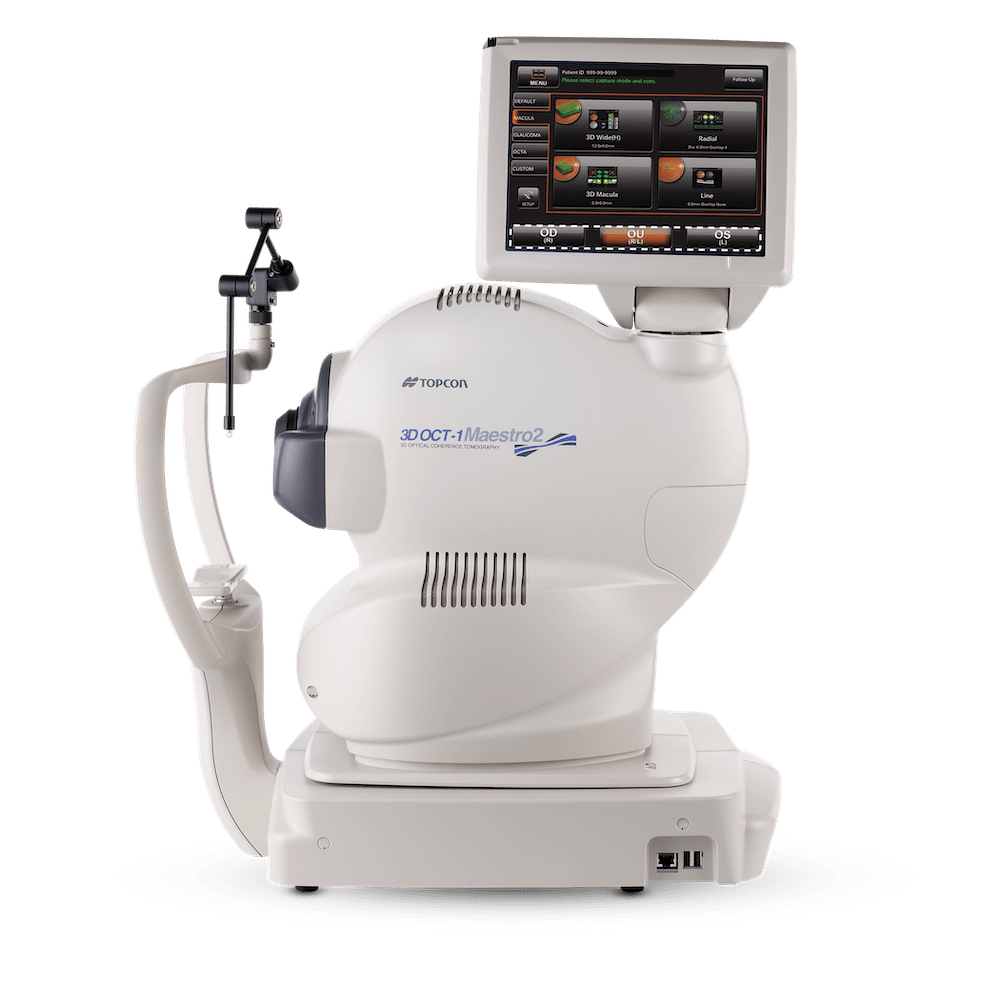
Maestro2 is the easy-to-use and affordable robotic OCT with color fundus photography.
- Hood DC. Improving our understanding, and detection, of glaucomatous damage: An approach based upon optical coherence tomography (OCT). Prog Retin Eye Res. 2017 Mar;57:46-75. doi: 10.1016/j.preteyeres.2016.12.002. Epub 2016 Dec 22. PMID: 28012881; PMCID: PMC5350042.Hood DC. Improving our understanding, and detection, of glaucomatous damage: An approach based upon optical coherence tomography (OCT). Prog Retin Eye Res. 2017 Mar;57:46-75. doi: 10.1016/j.preteyeres.2016.12.002. Epub 2016 Dec 22. PMID: 28012881; PMCID: PMC5350042.

Recent Posts
Expanding Access to Diabetic Retinopathy Screening in Rwanda
Topcon Joins Forces with Orbis International and Rwanda International Institute…
Read more
What to expect at Vision Expo West 2024
Don't miss out on this year's Vision Expo West at…
Read more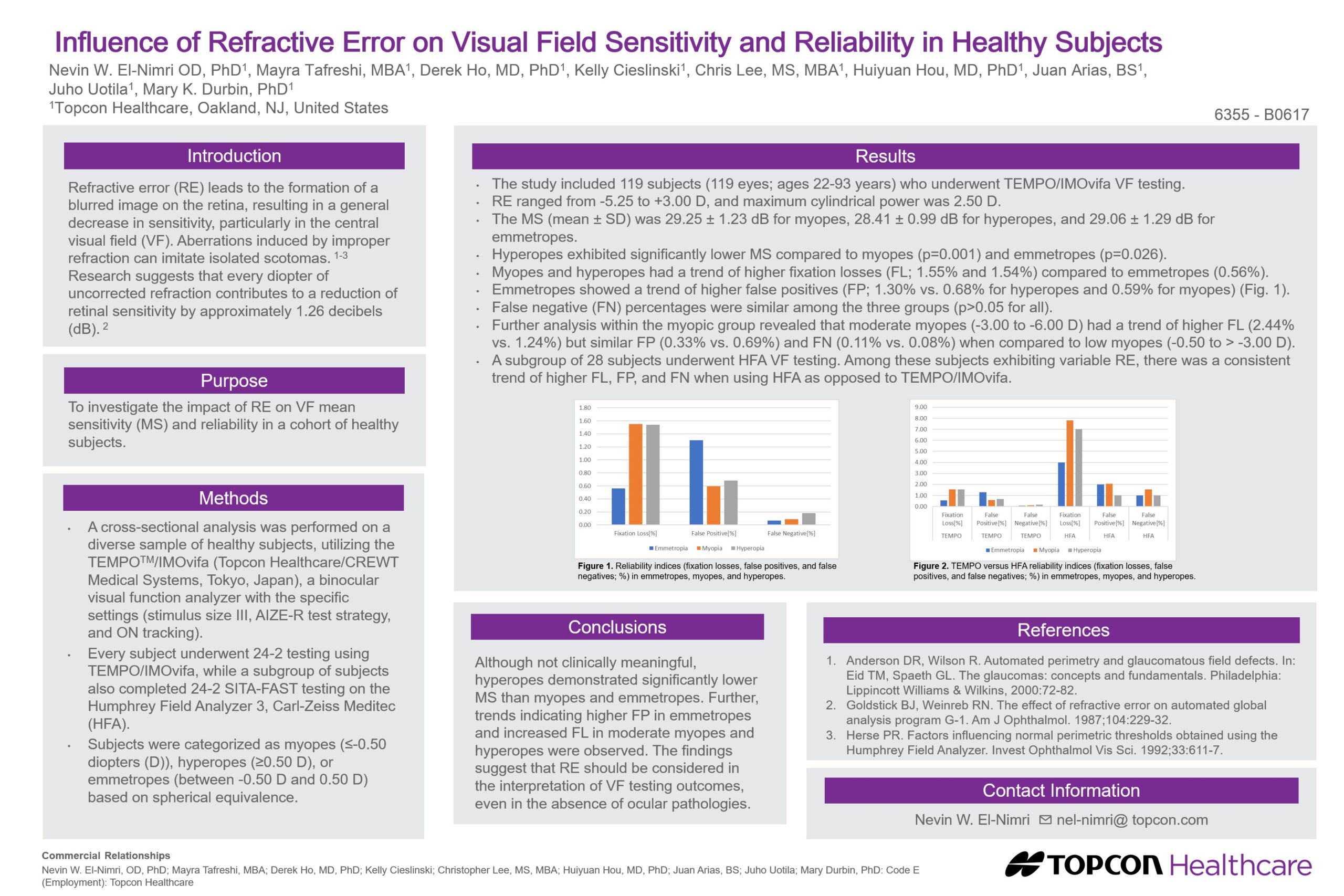
ARVO 2024 Cross-sectional Study on TEMPO Binocular Perimeter
This study investigates the impact of refractive error (RE) on…
Read more